
📱 What Percentage of Web Traffic Is on Mobile in 2026?
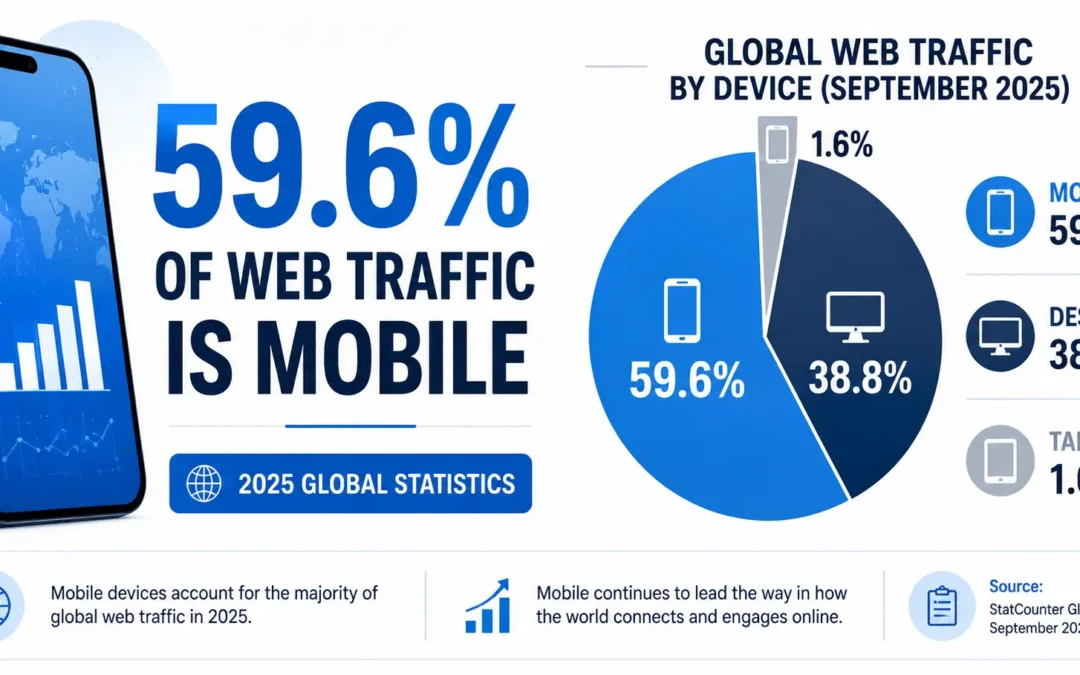
As of September 2026, 59.6% of global web traffic comes from mobile devices. Mobile continues to dominate worldwide internet usage, shaping how businesses design websites, run ads, and prioritize user experience.
📈 Key Stat: Mobile vs. Desktop Web Traffic Share (Global)
Mobile devices account for 59.6% of all global web traffic, while desktop devices account for 38.8%, and tablets make up the remainder.
Source: StatCounter GlobalStats
Global Web Traffic by Device (September 2026)
- Mobile: 59.6%
- Desktop: 38.8%
- Tablet: 1.6%
According to StatCounter, mobile traffic has held the majority share of global web usage since 2016.
🌍 Regional Differences
Mobile usage varies significantly by region:
- United States – Mobile devices make up 54.2% of traffic.
View US StatCounter Data - India – Mobile traffic reaches over 80%, reflecting a mobile-first internet user base.
View India StatCounter Data - Europe – Desktop traffic remains closer to 45–50%.
View Europe StatCounter Data
🕰 Trend Over Time
Mobile traffic has steadily grown over the past decade, surpassing desktop for the first time in 2016.
For historical trends and supporting data, see:
- StatCounter Global Historical Data
- Pew Research Center: Mobile Fact Sheet
- ITU ICT Indicators Database
📝 Why This Matters
Understanding the share of mobile traffic is crucial for:
- SEO & UX: Google’s mobile-first indexing prioritizes mobile versions of websites.
- Ad Campaigns: Mobile dominates impressions and clicks on most ad networks.
- Design Decisions: Mobile-responsive, fast-loading pages directly impact engagement and conversion rates.
Additional resources:
- Google Page Experience Guide
- DataReportal Global Digital Report 2026
- Similarweb Global Traffic Insights
📊 Mobile Traffic by Industry
Different industries see dramatically different levels of mobile traffic.
| Industry | Average Mobile Traffic |
|---|---|
| Retail & Ecommerce | 65-75% |
| Restaurants | 70-85% |
| Travel & Hospitality | 60-75% |
| Healthcare | 55-70% |
| Professional Services | 45-60% |
| B2B Technology | 35-55% |
Businesses that primarily serve consumers tend to see significantly higher mobile traffic than B2B organizations.
For example, an online clothing store may receive more than 70% of visits from smartphones, while a software company targeting corporate buyers may see closer to 50%.
Why This Matters
Understanding your industry's typical mobile share helps determine:
- Website design priorities
- Advertising strategies
- Conversion optimization efforts
- Mobile performance requirements
🚀 How Mobile Traffic Impacts Conversion Rates
Mobile users behave differently than desktop users.
Common mobile browsing behaviors include:
- Shorter browsing sessions
- Faster decision making
- More local searches
- Higher bounce rates on slow websites
- Increased use of click-to-call actions
According to Google research, even a one-second delay in page load time can significantly reduce conversions.
Businesses should focus on:
- Fast page speed
- Mobile-friendly navigation
- Large tap targets
- Click-to-call buttons
- Simplified forms
📱 Mobile Traffic vs Mobile Purchases
Although mobile drives most website visits, desktop often generates a larger percentage of completed purchases and lead forms.
This phenomenon is known as cross-device behavior.
A typical customer journey may look like:
- Discover a business on mobile.
- Research products or services.
- Return later on desktop.
- Complete the purchase or submit a lead form.
This is why businesses should optimize both mobile and desktop experiences rather than focusing exclusively on one device type.
⚠️ What Happens If Your Website Isn't Mobile Friendly?
Websites that perform poorly on mobile devices often experience:
- Lower Google rankings
- Higher bounce rates
- Reduced conversion rates
- Poor user engagement
- Lower advertising ROI
Common mobile issues include:
- Text that is difficult to read
- Buttons that are too small
- Slow loading times
- Content wider than the screen
- Broken forms
Google uses mobile-first indexing, meaning the mobile version of your website is the primary version used for ranking and indexing.
📈 Mobile Traffic Statistics at a Glance
Quick facts about mobile internet usage:
- 59.6% of global web traffic comes from mobile devices.
- Mobile traffic has exceeded desktop traffic since 2016.
- In many developing countries, mobile traffic exceeds 80%.
- More than half of all Google searches are performed on mobile devices.
- Most social media usage occurs on smartphones.
- Mobile users expect pages to load in under three seconds.
This section is excellent for featured snippets and AI Overviews because it summarizes the article in a scannable format.
FAQ Section
Frequently Asked Questions
What percentage of web traffic comes from mobile devices in 2026?
As of September 2026, mobile devices account for 59.6% of global web traffic, according to StatCounter.
Is mobile traffic higher than desktop traffic?
Yes. Mobile traffic accounts for 59.6% of global traffic compared to 38.8% from desktop devices.
When did mobile traffic surpass desktop traffic?
Mobile web traffic first exceeded desktop traffic globally in 2016 and has remained the dominant source of traffic ever since.
Which countries have the highest mobile traffic share?
Countries such as India, Indonesia, Nigeria, and many other mobile-first markets often see mobile traffic exceeding 75-80% of total web usage.
Does Google use mobile traffic for rankings?
Google uses mobile-first indexing, meaning it primarily evaluates the mobile version of a website when determining search rankings.
Why is mobile optimization important?
Mobile optimization improves user experience, search rankings, engagement, lead generation, and conversion rates.
What is considered a mobile-friendly website?
A mobile-friendly website loads quickly, displays properly on smartphones, uses readable text, and allows users to navigate easily without zooming.
How can I check my website's mobile traffic?
You can view mobile traffic data in:
- Google Analytics 4
- Google Search Console
- StatCounter
- Similarweb
Do mobile users convert as well as desktop users?
Mobile users generate a large share of traffic, but desktop users often complete more purchases and form submissions. Many customers research on mobile and convert later on desktop.
What percentage of Google searches are performed on mobile?
Google does not publish an official current percentage, but industry studies consistently show that the majority of searches occur on mobile devices.
📚 Sources
- StatCounter GlobalStats. Platform Market Share Worldwide, September 2026.
https://gs.statcounter.com - Pew Research Center. Mobile Fact Sheet.
https://www.pewresearch.org/fact-sheet/mobile-technology-and-home-broadband/ - International Telecommunication Union (ITU). ICT Indicators Database.
https://www.itu.int - Google Search Central. Mobile-First Indexing Best Practices.
https://developers.google.com/search/mobile-sites/mobile-first-indexing
📅 Last Updated: June 2026
About ITGuys
ITGuys is a Managed IT Support company that has been helping businesses solve technology problems since 2009. We work with companies of all sizes to provide reliable, practical IT solutions that keep teams productive and secure.
Our services include managed IT support, network cabling, office onboarding and offboarding, email migration, IT consulting, wireless networking, infrastructure upgrades, and ongoing technical support for businesses across the United States.
We believe technology should make business easier — not more frustrating. Our goal is to provide straightforward IT guidance that helps businesses avoid downtime, improve reliability, and make smarter technology decisions.
Recent Comments