
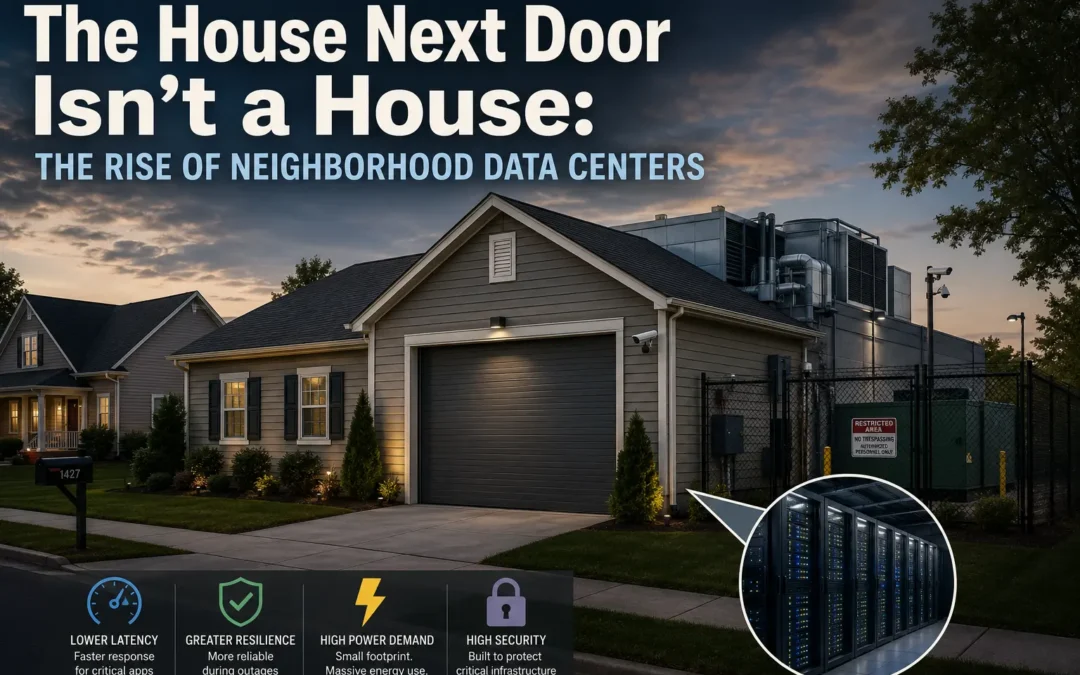
Drive through almost any suburban neighborhood and the pattern is instantly familiar: manicured lawns, mailboxes, driveways, homes that blend into one another like a well-rehearsed chorus.
But every once in a while, there's one that feels off.
It has siding. A roof. Shutters. Maybe some ornamental shrubbery out front. From a car window, it looks completely ordinary.
Except for a few things.
There's no front door. No porch. No lights glowing through the windows at night. No Amazon packages, no kids' bikes on the sidewalk, no curtains, no cars. Just a large garage door, security cameras mounted high on the corners, industrial ventilation equipment humming quietly out back, and an almost eerie sense that no one has ever, or will ever, live there.
Welcome to the neighborhood data house. It might already be on your street.
Want to see more content like this? Add us as a Preferred Source on Google to see more of our articles when you search.
The Internet Has a Body, and It's Getting Closer to Yours
Most people imagine the internet living somewhere far away: enormous, faceless warehouses humming in the Nevada desert or rural Virginia, stacked floor to ceiling with blinking servers.
That picture isn't wrong. Those hyperscale facilities are very real.
But they're only part of the story. Beneath public awareness, a different layer of digital infrastructure has been quietly expanding, one that doesn't announce itself with cooling towers and industrial signage. Instead, it hides behind vinyl siding and decorative shutters in communities across the country.
These are edge computing facilities, micro data centers, and telecommunications hubs. Their job is simple: move computing power closer to where people actually live. Every Google search, Netflix stream, ChatGPT conversation, Ring doorbell alert, and cloud backup has to run somewhere. The closer that "somewhere" is to you, the faster and more reliably it works.
From a pure engineering standpoint, it's elegant. From a community standpoint, it's raising some questions worth asking.
Designed to Disappear
The most striking thing about these buildings isn't that they exist. It's how deliberately invisible they are.
Architects often design them to pass as homes: residential rooflines, matching siding, windows that may or may not actually open onto anything. Drive past one without knowing what you're looking at and you might never give it a second thought. Here's a great example: A 2.4 million dollar Dallas home boasting a small data center right in the living room. From the outside this looks like a normal house (albeit a little big for the neighborhood), but it has no bathrooms, bedrooms, kitchen or anything you would expect, just an office and a data center.
But walk up close and the illusion starts to crack. There's no doorbell. No mailbox slot. No welcome mat. The "windows" don't have blinds or light behind them. The landscaping is neat but somehow impersonal, like something maintained by contract rather than by someone who actually has to look at it every morning. Around back, you'll find reinforced walls, backup generators, and HVAC equipment that sounds less like a home air conditioner and more like something from a light industrial park.
These buildings are purpose-built to not look like what they are.
Which raises a question that's harder to dismiss: if critical infrastructure is intentionally disguised as a home, do the people living next to it have a right to know?
Why Companies Love Them (And Why That's Actually Reasonable)
Before this becomes a full-throated grievance piece, it's worth being fair.
There are genuinely good reasons to put computing infrastructure close to neighborhoods. Modern applications, including video calls, AI tools, autonomous vehicles, emergency communications, and smart home devices, all benefit from servers that are physically nearby. The technical term is low latency, but what it means in practice is that things work better when the computer handling your request isn't three states away.
Edge facilities process information locally. Less network congestion. Faster response times. Greater resilience when a distant data center goes down. In many cases, the infrastructure hidden inside that camouflaged house on Maple Street is directly supporting services the people on that street use every single day.
These facilities aren't inherently sinister. They're practical.
But practicality and transparency aren't mutually exclusive, and right now, we're mostly getting one without the other.
The Transparency Problem Nobody's Talking About
Infrastructure has always been visible.
Power substations look like power substations. Water treatment plants don't try to pass as apartment buildings. Cell towers sometimes wear disguises, fake trees, church steeple skins, but they're generally recognizable once you know what you're looking for.
Neighborhood data houses are different. They're not just disguised; they're architecturally indistinguishable from the real thing. And that creates a transparency gap that's genuinely new.
Most homeowners understand what they're getting into when they buy near a utility corridor or a rail line. Those things are visible on a map, on a drive-through, in a conversation with a realtor. You can factor them into your decision.
Few people expect to buy next to what appears to be an empty colonial, only to learn months or years later that it's a secured, continuously operating computing facility drawing enormous amounts of power and generating industrial-grade noise from its cooling systems.
Whether that changes your opinion of the neighborhood or not almost doesn't matter. The point is that people generally want to know. And right now, many don't.
What It's Actually Like to Live Next Door
Supporters of these facilities often highlight what they don't bring: almost no traffic, few or no on-site workers, and none of the obvious commercial activity that would transform a neighborhood's character overnight.
That's true. But it doesn't mean they're invisible to the people who actually live nearby.
Noise is the most immediate concern. Large server rooms generate heat. Heat requires cooling. Cooling requires industrial HVAC systems running around the clock. Backup generators, which all these facilities have, are tested on regular schedules, producing sudden and significant bursts of sound. For a neighbor with a bedroom window facing the facility, this is not a minor inconvenience.
Power draw is significant. Modern computing facilities consume electricity at a scale wildly disproportionate to their footprint. That often requires upgraded transformers and electrical infrastructure, changes that affect the surrounding grid in ways residents rarely have visibility into.
Security presence can subtly shift the feel of a street. High-resolution surveillance cameras, reinforced construction, restricted-access signage, and the occasional security check can make an otherwise residential block feel like something different, because something different is there.
And then there's the harder-to-quantify issue of community character. Neighborhoods are social spaces. Homes represent people, families, and shared life. When residential architecture becomes a shell for industrial technology, even benign and practically useful technology, it quietly changes the purpose of the built environment. Not in a dramatic way. But in a way that people who live there tend to feel before they can name it.
AI Just Made This Urgent
Five years ago, this was a niche infrastructure issue that most people would never have reason to think about.
The AI boom changed that math considerably.
Large language models, image generation, real-time inference, autonomous systems: these technologies require staggering and rapidly growing amounts of computing power. Demand is accelerating faster than hyperscale facilities can keep up. Industry analysts expect thousands of new computing facilities of various sizes to be built over the next decade, many of them needing to be located close to population centers rather than in remote industrial zones.
The question is no longer whether neighborhood data houses will become more common. It's how communities will be treated when they do.
Should We Know They're There?
Imagine if electrical substations were required to look like single-family homes. Most people would object, not because the substation is dangerous, but because hiding its purpose feels like a breach of something basic. A kind of architectural dishonesty.
There's a reasonable conversation to be had about whether neighborhood data centers deserve similar scrutiny. Should zoning boards require disclosure? Should nearby homeowners be notified before construction? Should there be limits on how completely a commercial or industrial facility can mimic a residential structure?
Reasonable people can disagree on the answers. But the conversation is worth having before this becomes so widespread that the window for shaping it has closed.
The irony is that communities are often remarkably willing to support infrastructure they understand. What people resist isn't the technology. It's the feeling of being treated as a problem to route around rather than a neighborhood worth being honest with.
The House That Works While You Sleep
There's something almost poetic, in a quietly unsettling way, about the neighborhood data house as a symbol of how the internet actually works.
We've built a world where more and more of daily life, banking, healthcare, communication, entertainment, memory, lives in something we call "the cloud," a word specifically chosen to suggest weightlessness and distance. The infrastructure that makes all of it possible is, in reality, intensely physical: millions of buildings, cables, transformers, cooling systems, and servers occupying real space in real places.
Some of those places now look like houses on quiet streets. They don't have families. They don't have front doors. They don't have anyone turning the porch light on at night.
But they're working harder than almost anything else on the block.
Next time you drive through your neighborhood and spot a house that feels subtly wrong, too quiet, too neat, too absent, it might be worth wondering what's really happening inside.
And whether anyone thought to tell you.
About ITGuys
ITGuys is a Managed IT Support company that has been helping businesses solve technology problems since 2009. We work with companies of all sizes to provide reliable, practical IT solutions that keep teams productive and secure.
Our services include managed IT support, network cabling, office onboarding and offboarding, email migration, IT consulting, wireless networking, infrastructure upgrades, and ongoing technical support for businesses across the United States.
We believe technology should make business easier — not more frustrating. Our goal is to provide straightforward IT guidance that helps businesses avoid downtime, improve reliability, and make smarter technology decisions.
Recent Comments