
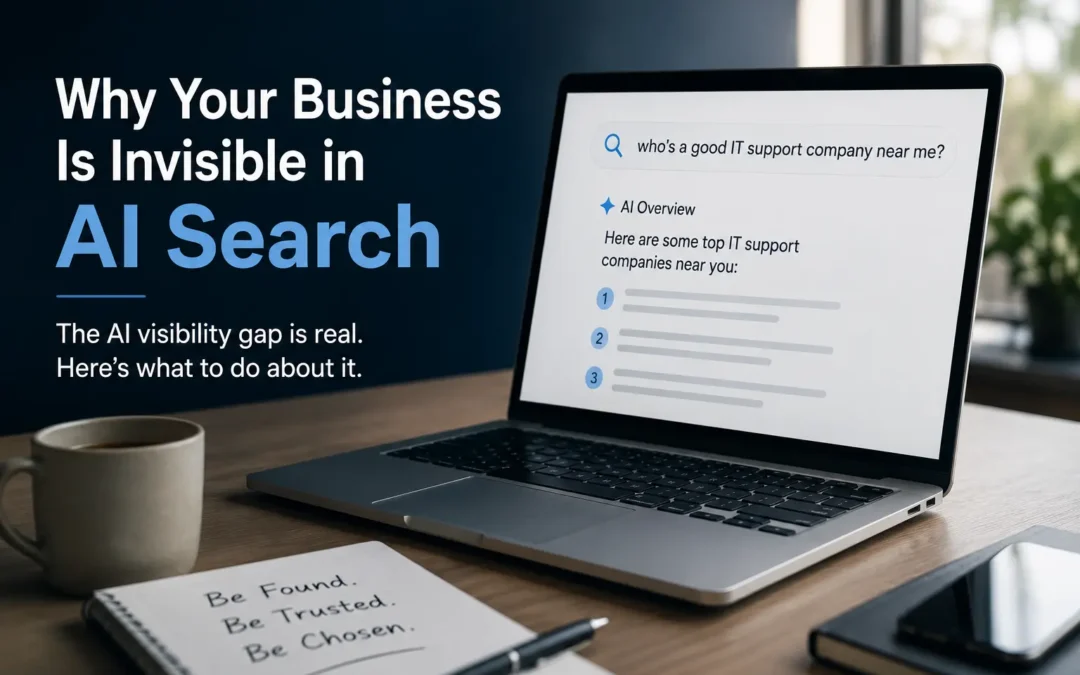
A growing number of business owners are running the same small experiment. They open ChatGPT or Perplexity, type in the kind of question a real customer would ask, something like "who's a good IT support company near me" or "best HVAC repair in Denver" and wait to see if their own name shows up.
Often, it doesn't. Three competitors get named instead, described in confident detail, while the business that has been operating for years sits completely outside the conversation. There's no error message and no obvious reason. The AI isn't ranking the business lower. It simply doesn't know the business exists.
That gap is becoming a real business problem, not a hypothetical one. A 2026 benchmark study of more than 200 U.S. service businesses found the average company scores just 30 out of 100 on AI visibility, meaning roughly 70% of the opportunity to be found through AI-powered search is currently going unclaimed. Most small businesses aren't losing this game on purpose. They simply haven't been told the rules changed.
Want to see more content like this? Add us as a Preferred Source on Google to see more of our articles when you search.
What's actually changed, in plain terms
For twenty years, being found online mostly meant one thing: rank well on Google. That still matters, but it's no longer the whole game. Search results now regularly open with an AI-generated summary that answers the question directly, and a growing share of searches end right there, with no click to any website at all.
The numbers back this up. Seer Interactive tracked over 25 million search impressions across more than 40 organizations and found that organic click-through rates on queries showing an AI Overview fell by roughly 61% between mid-2024 and late 2025. The same research found something worth paying attention to: businesses that were actually cited inside the AI Overview saw about 35% higher organic click-through than average, while everyone else absorbed the loss. Being present in the answer is no longer a nice bonus. It's increasingly the difference between getting the click and getting skipped entirely.
Here's the part that catches most small businesses off guard: AI platforms don't agree with each other. Research analyzing well over 100,000 AI-generated responses found that only about 11% of the sources cited overlapped across ChatGPT, Perplexity, Claude, and Google's AI Mode. Showing up in one doesn't mean showing up in the others. This isn't a single battle for one ranking spot anymore. It's several smaller battles happening on different platforms, each with its own rules for who gets mentioned.
Ranking well on Google doesn't automatically carry over
A common assumption is that a business already doing well in traditional search has nothing to worry about. That's only partly true. Businesses that rank on page one of Google get mentioned in ChatGPT roughly six times out of ten, which sounds decent until you realize it means a well-established, well-ranked business is still left out of the answer close to 40% of the time.
Traditional SEO and AI search optimization overlap, but they aren't the same discipline. Google's own ranking systems and a chatbot's citation process work on different logic. A page can rank well because of links, keywords, and years of domain authority, while still getting passed over by an AI system that's looking for something more specific: a clean, direct, quotable answer to the exact question it's trying to resolve.
The honest truth about schema markup (it's not the shortcut you've been sold)
If you've read anything about AI search optimization recently, there's a good chance someone told you the fix is schema markup, the behind-the-scenes code that labels what's on a page. It's pitched constantly as the lever that gets a business cited. The actual evidence tells a more complicated story, and it's worth knowing before anyone spends a weekend implementing it for the wrong reason.
In May 2026, the SEO research firm Ahrefs published one of the more rigorous studies done on this question. They tracked 1,885 pages that added structured data schema and compared them against 4,000 similar pages that didn't, measuring citation changes across Google AI Overviews, AI Mode, and ChatGPT over a seven-month window. The result: adding schema produced no meaningful citation increase on any platform. In fact, Google AI Overview citations dropped slightly on the pages that added it, a small but statistically real decline the researchers couldn't fully explain.
Google's own developer documentation backs this up directly, stating plainly that there's no special schema.org markup required to appear in AI Overviews or AI Mode. A separate real-time test of five major AI systems found that when they fetch a page, they read the visible text on the page and largely ignore hidden structured data entirely. None of this makes schema markup worthless. It's still genuinely useful for earning star ratings and FAQ dropdowns in classic search results, and for helping Google correctly tell a business apart from others with similar names. It just isn't the AI citation shortcut it's been marketed as. If the only reason a business is adding it is to chase AI mentions, that time is likely better spent elsewhere.
What actually earns an AI citation
Strip away the hype and the pattern that shows up again and again across the research is less technical than most people expect. AI systems are built to extract a confident, specific answer and attribute it to a source. The businesses that get cited consistently tend to do a handful of things well.
They answer the actual question, plainly, near the top of the page. Content that states the answer in the first sentence or two gets picked up far more reliably than content that saves the answer for paragraph four, after a story about how the company got started. A number beats an adjective every time. "Most local network cabling jobs run $150 to $400 per drop" gives an AI system something to quote. "Affordable, professional service" gives it nothing to work with.
They're consistent about who they are, everywhere. Business name, address, phone number, and service description should match exactly across the website, Google Business Profile, and every directory listing. AI systems lean heavily on entity recognition, meaning they need to be confident a business is a real, single, identifiable thing before they'll recommend it. Inconsistent listings create doubt, and doubt gets a business left out.
They get mentioned by other people, not just by themselves. A glowing paragraph on a company's own homepage carries far less weight than a mention in a review, a local news writeup, or an industry directory. Third-party sources are exactly what AI systems are designed to cross-reference for trust.
They build depth on a topic instead of publishing one perfect page. A single well-optimized article rarely outperforms a body of genuinely useful content that shows a business actually knows the subject. This is the same logic behind topical authority in traditional SEO, and it applies just as much here.
See where your own business actually stands
Reading about AI visibility is one thing. Knowing where a specific business currently stands is another. The quick self-check below walks through the factors that research consistently ties to AI citations, the ones covered above, not schema markup or technical tricks, and gives an honest read on where the gaps are.
AI Search Visibility Self-Check
Eight quick questions. Answer honestly, based on how your business actually shows up today, not how you'd like it to.
This is a directional self-assessment based on publicly documented AI citation patterns, not a guarantee of how any specific AI platform will treat your business.
Where to start this month
None of this requires a rebuild or a big budget. The businesses making real progress tend to start small and specific:
- Rewrite the homepage and top service pages so the core answer, what you do, who it's for, and roughly what it costs, appears in the first sentence or two, not buried after a brand story.
- Run a name, address, and phone number audit across your website, Google Business Profile, and every directory listing, and fix mismatches.
- Build or refresh a genuine FAQ page using the actual questions customers ask before they call, not invented ones.
- Ask a handful of recent customers for a detailed review, not just a star rating. Specific, third-party language is exactly what AI systems look for.
- Check back in occasionally. AI citation behavior isn't static, and Google's own search data shows AI Overviews are still evolving, which means today's gaps may not be tomorrow's gaps.
Traditional SEO isn't going away, and everything covered here builds on it rather than replacing it. What's changed is that being found now depends on being clear enough, and credible enough, that a machine can confidently vouch for you in a single sentence. That's a higher bar in some ways, and a more honest one in others. It rewards businesses that are straightforward about what they do and who they serve, which, coincidentally, is also just good business.
About ITGuys IT Support & Consulting
For 15 years, ITGuys has helped small and mid-sized businesses manage the technology decisions that actually move the needle, from everyday IT support to the security and compliance work that protects what you've built. If your software stack has grown faster than your visibility into it, that is exactly the kind of problem we help sort out.
Managed IT Services | Cybersecurity | Compliance Support | Contact Us
Recent Comments