
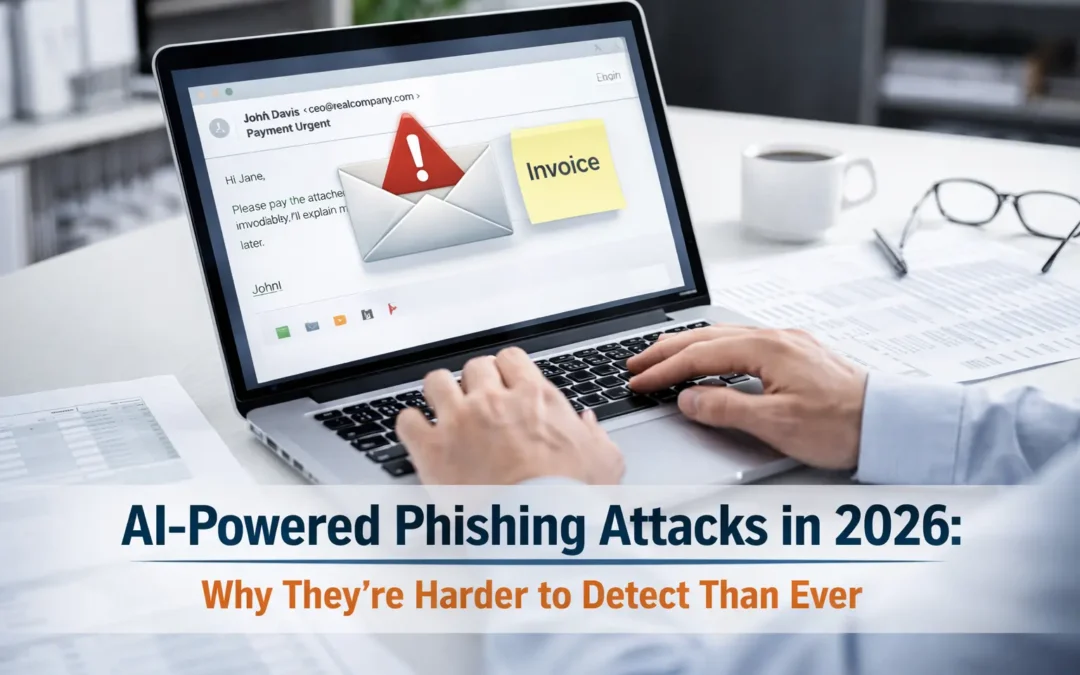
Phishing has always been one of the most effective ways for attackers to get into business systems. That has not changed. What has changed is how these attacks are created.
In 2026, phishing is becoming more dangerous because the tools behind it have improved dramatically. Artificial intelligence systems like ChatGPT allow attackers to generate realistic, well-written messages in seconds. These messages no longer look suspicious. In many cases, they look exactly like normal business communication.
This creates a serious problem for organizations. The old approach to phishing detection is no longer reliable, and many employees are being caught off guard.
The Evolution of Phishing: From Obvious to Subtle
Not long ago, phishing emails were relatively easy to spot. They often contained spelling mistakes, awkward phrasing, or generic greetings. Most people knew to be cautious.
That is no longer the case.
Modern phishing emails are clean, professional, and often tailored to the person receiving them. Attackers can match tone, reference real situations, and even imitate specific individuals within a company.
The biggest shift is simple. Phishing no longer stands out. It blends in.
How Attackers Are Using AI to Scale Phishing
Hyper-realistic email generation
AI tools make it easy to produce emails that sound natural. Attackers can quickly generate messages that match a company’s communication style and include believable details. These emails often reference vendors, projects, or internal processes, which makes them feel legitimate.
Personalization at scale
In the past, sending personalized phishing emails took time. Now it can be done instantly.
Attackers can target specific roles within a company, such as finance, HR, or IT. Each message can be adjusted to match the responsibilities and expectations of that role. This level of targeting significantly increases the chances of success.
Multi-step conversations
Phishing is no longer limited to a single message. It often develops over time.
Attackers use AI to respond to replies, maintain context, and gradually build trust. By the time a request is made, it does not feel unusual. It feels like part of an ongoing conversation.
Voice and deepfake support
Email is just one piece of the attack.
It is now common for phishing attempts to include follow-up phone calls or voice messages. In some cases, attackers use AI-generated voices to sound like executives or coworkers. This added layer of realism can push employees to act quickly without verifying the request.
Why Phishing Is Harder to Detect Than Ever
Traditional warning signs are disappearing
Many employees were trained to look for poor grammar, strange formatting, or unusual wording. Those signals are becoming less useful.
AI-generated messages are polished and consistent. They often look better than legitimate emails.
Trust is being exploited
Attackers frequently gain access to real email accounts and continue existing conversations. When a message comes from a known contact and includes familiar context, it is much harder to question.
Security tools are under pressure
Many email security systems rely on known patterns or previously identified threats. AI-generated phishing messages are different each time, which makes them harder to flag.
Common Examples of AI-Powered Phishing Attacks
To understand the risk, it helps to look at how these attacks appear in day-to-day business operations. Most of them do not feel unusual at first glance.
Fake invoice or payment requests
An employee in accounting receives an email from what appears to be a vendor. The message includes a well-formatted invoice and a request for payment.
The details look correct. The tone is professional. In some cases, the attacker references real past work.
This works because the message fits into normal workflow. There is nothing obviously wrong with it.
Executive impersonation
An employee receives a message that looks like it came from a company executive. The request is urgent. It may involve a wire transfer or a quick purchase.
The wording matches how that executive normally communicates. There are no obvious errors.
The pressure to act quickly is what makes this effective.
Account security alerts
A user receives a notification about suspicious activity or a password issue. The message includes a link to log in and resolve the problem through a page that looks like Microsoft 365.
The page appears legitimate. The user enters their credentials, and the attacker captures them immediately.
Conversation hijacking
In this scenario, an attacker gains access to a real email account. Instead of starting a new conversation, they join an existing one.
They respond naturally, using the same tone and context as previous messages. At some point, they introduce a change, such as updated payment instructions.
Because the message comes from a trusted source, it often goes unquestioned.
Fake IT support requests
An employee receives a message that appears to come from the IT team. It may ask them to reset a password, install software, or confirm login details.
These requests are common in most organizations, which makes them easy to overlook.
File sharing requests
A user receives a message indicating that a document has been shared with them. The link leads to a login page that looks like a standard file-sharing platform.
The user logs in to view the document, but the credentials are captured instead.
Voice-based follow-ups
After an initial email, the employee may receive a phone call confirming the request. The caller sounds convincing and may even resemble someone within the company.
This combination of email and voice communication increases trust and urgency.
AI Phishing Attack Trends in 2026
Several patterns are becoming clear.
Phishing remains one of the most common ways attackers gain access to systems. The use of AI is increasing, especially in targeted attacks against small and mid-sized businesses. These organizations are often seen as easier targets.
Credential theft continues to be a primary goal. Once attackers gain access to an account, they can expand their reach quickly.
One important point stands out. The effectiveness of phishing is not declining. In many cases, it is improving.
Real-World Business Risks
The impact of a successful phishing attack can be significant.
Unauthorized access to email and cloud systems is often the first step. From there, attackers may initiate financial transactions, access sensitive data, or deploy additional threats such as ransomware.
Even a single compromised account can lead to wider exposure across the organization.
How Businesses Can Defend Against AI Phishing
Update security awareness training
Training should reflect current threats. Employees need to see realistic examples and understand how modern phishing works. Ongoing training is more effective than a once-a-year approach.
Strengthen email security
Basic filtering is not enough. Businesses should look for solutions that analyze behavior, detect anomalies, and evaluate links and attachments in real time.
Improve identity protection
Multi-factor authentication is still important, but it should be combined with additional controls such as device verification and conditional access policies.
Add verification steps for financial actions
Any request involving money should require confirmation through a second channel. This could include a phone call or in-person approval.
Monitor account activity
Unusual login attempts, unexpected forwarding rules, and changes in behavior should be investigated quickly. Early detection can prevent further damage.
Shift to a verification-first mindset
Employees should feel comfortable slowing down and confirming requests. Trust should be based on verification, not assumption.
The Bottom Line
Phishing is not new, but it has changed in a meaningful way.
AI has made these attacks more convincing and easier to execute at scale. Messages that once stood out now blend into everyday communication.
For businesses, this means the problem can no longer be treated as a simple user error. It requires a broader approach that includes technology, training, and clear internal processes.
Organizations that adapt will reduce their risk. Those that rely on outdated methods will continue to be exposed.
FAQs: AI Phishing Attacks
What is AI-powered phishing?
It is the use of artificial intelligence to create realistic and targeted messages designed to trick users into sharing information or taking action.
Why is phishing harder to detect now?
Because modern messages are well-written, personalized, and often based on real information. The usual warning signs are less common.
Can employees still learn to identify phishing?
Yes, but training needs to reflect current attack methods and include realistic scenarios.
Is multi-factor authentication enough?
It helps, but it is not a complete solution. Attackers are finding ways to work around it, especially through social engineering.
Who is most at risk?
Small and mid-sized businesses are frequent targets because they often have fewer security resources.
What is the most effective defense?
A combination of strong security tools, updated training, and clear verification procedures.
This article was prepared by the team at ITGuys IT Support & Consulting. We deliver managed IT services, cybersecurity, cloud solutions, data backup, and responsive support to help businesses stay secure and operate efficiently.
Whether you’re in Denver or anywhere across the U.S., ITGuys is here to support your technology needs.
Contact ITGuys Today!
Denver Office – Local IT Support & Consulting
National Services – Managed IT Solutions Across the U.S.
Recent Comments